Latest Post

He was born in 1914 in Hoshiarpur. He was commissioned into the 16th Punjab Regiment in 1943. In
August 1958, Major Tufail Muhammad, a Company Commander in the East Pakistan Rifles, and his patrol encircled an Indian post in the Lakshmirpur area. And, though mortally wounded in the hand-to-hand encounter that followed, Major Tufail Muhammad continued to lead his troops till the Indians were driven out, leaving four dead and three prisoners. He embraced martyrdom the same day i.e, 7 August 1958.


Tufail Mohammad (Urdu: طفیل محمد; c. 1914 – 8 August 1958) was born in 1914 in reputable[3][4] family of Hoshiarpur, Punjab. He was commissioned into the 1/16th Punjab Regiment in 1943.

Tufail Mohammad embraced shadaat in a pre Indo-Pakistani War of 1965 border skirmish and was awarded the Nishan-e-Haider. He is the only person to win the award for an action outside the Indo-Pakistan Wars.

In 1958, Major Tufail Muhammed was posted to East Pakistan as company commander of a battalion of East Pakistan Rifles (a paramilitary force for border security). During his command, Indian troops violating international borders captured a village in the area of Laskhmipur of East Pakistan. On 7 August 1958 Major Tufail launched an assault, to force withdrawal of Indian troops from the village. He divided his men into three groups and attacked the Indian troops during the hours of darkness. The groups were able to reach the enemy without being detected but as the firefight started, the group came under heavy fire and Major Tufail received three bullets in his stomach. Despite being shot in stomach, he kept moving and was able to silence the incoming fire from machine gun. By tactically using grenades, Major Tufail was able to destroy key enemy posts. When he saw an enemy commander inflicting heavy casualties to his men he crawled towards enemy posting and engaged the enemy in hand-to-hand battle which resulted in the killing of a commander of the Indian Army. He killed him by hitting him with his steel helmet on the face. He continued the operation with his men which resulted in the withdrawal of Indian forces. Despite being heavily injured, he called his junior officer "I have completed my duty; the enemy is on the run." He was rushed to hospital but he succumbed to the injuries on 8 August.

Mohammad was buried with full military honours in his native city Burewala Punjab. His native village has been named after him and is now known as Tufailabad or Tufail Abad.


Major Tufail Muhammad Nishan-i-Haider

6 september 1965, information about 6 september(defence day), 6 september defence day 2017, 6 september history, defence day essay, information about 6 september(defence day) in urdu, defence day short essay in english, defence day speech


He was born in 1910 in Village Sanghori, District Rawalpindi. He was commissioned into the Punjab Regiment, in 1944. During the Kashmir Operations soon after the birth of Pakistan, as a Company Commander in the 2nd Battalion of the Punjab Regiment, Captain Muhammad Sarwar launched an attack causing heavy casualties against a strongly fortified enemy position in the Uri Sector under heavy machine-gun, grenade and mortar fire. But on 27 July 1948, as he moved forward with six of his men to cut their way through a barbed wire barrier, he got martyrdom when his chest was hit by a burst of automatic fire.
Captain Muhammad Sarwar Nishan-i-Haider - Defence Day


6 september 1965, information about 6 september(defence day), 6 september defence day 2017, 6 september history, defence day essay, information about 6 september(defence day) in urdu, defence day short essay in english, defence day speech


He was born on 25 April 1922 in Khandbaz Tehsil Nakial (Azad Jammu & Kashmir). He was enlisted
in the Royal Corps of Engineers in British Indian Army on 18 March 1941. After completing his service in the British Indian Army in 1947, he came back to his native town and started establishing Haidri Force with the support of Sardar Fateh Muhammad Karailvi. On 1st Janaury 1948, Haidri Force was raised as “Sher-e-Riasti Battalion” under the command of Lt. Col. Muhammad Sher Khan. Due to his unflinching devotion and undaunted courage, on the recognition of his dedication and commitment to the cause, he was accoladed with the rank of Naik and was made platoon commander. He set personal examples of gallantry and inflicted heavy losses on the enemy at Bhudha Khanna where his platoon was given the responsibility to defend Budha Khanna where he faced never-ending frontal and crossfire from machine guns. He defended the post with chivalry, which he established with his few jawans and repulsed many aggressive ventures by the enemy and imposed colossal losses on them. The enemy used every mean to capture the post with two companies attack and heavy Arty bombardment but with unwavering determination and passion for Martyrdom bought the enemies on their knees. Despite facing all odds, he led his jawans while setting personal example of bravery and valour and remained steadfast and unmoved on the post. During the course of action, despite being hit on his chest by Arty fire, he retained his position and frustrated the Indian assault. Due to severe injuries he embraced Martyrdom on 26 October 1948. On 14th March 1949, the Defence Council of Azad Jammu & Kashmir adorned him with Hilal-e-Kashmir (posthumous) and on 30th November 1995 Government of Pakistan initiated the gazette notification to declare his Hilal-e-Kashmir equilent to Nishan-e Haider.

Naik Saif Ali Janjua Nishan-i-Haider - Defence Day  

An Independence Day is an annual event commemorating the anniversary of a nation's independence or statehood, usually after ceasing to be a group or part of another nation or state; more rarely after the end of a military occupation; and in the unique case of Singapore, expulsion from Malaysia. Most countries observe their respective independence days as national holidays.
Defence Day (Yaum-i Difāʿ) is a public holiday that is celebrated as national day to commemorate in the memory of Pakistan's successful defence against India that marked the ceasefire in the 1965 war on 6 September.

Indo-Pakistani war of 1965

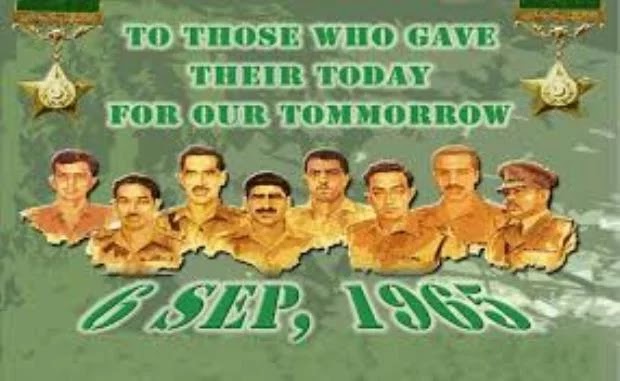
Army officers like Captain Sarwar, Major Tufail, Major Raja Aziz Bhatti, Major Shabbir Sharif, Major Muhammad Akram, Muhammad Hussain Janjua, Lance Naik Muhammad Mehfooz, and Havaldar Lalak Jan sacrificed their lives for Pakistan and were awarded with "Nishan-e-Haider" for their acts of exceptional bravery. Nishan-e-Haider is the highest military award given to soldiers of the army of Pakistan for their exceptional and remarkable bravery and sacrifice for their nation and country.

Celebrations and Parades

Army of Pakistan displays their latest missiles, tanks, guns, army aviation helicopters and armament being used by Engineers, Electrical and Mechanical Corps, Army Air Defense, Signals, Army Service Corps and Army Medical Corps live on various places. Everyone is allowed to watch such functions live by going to the specific places. These shows are displayed on national channels as well. National songs and special documents about 6 September 1965 and martyred people of 6 September are displayed on TV. It is told to people how people gave sacrifices for the defense of the country and what is the responsibility of young generation now especially the children who are the future of Pakistan.
Defence Day celebrates the discipline, professionalism and patriotism of the Pakistan Armed Forces. It essentially celebrates the defence of Lahore in 1965.
The change of guard ceremony takes place at Mazar-e-Quaid, Karachi, where the cadets of Pakistan Air Force Academy present Guard of Honour and take the charge.

Watch Pakistan Defence Day 6 September 2016 Ceremony in GHQ Rawalpindi on Dunya News.


6 september 1965, information about 6 september(defence day), 6 september defence day 2017, 6 september history, defence day essay, information about 6 september(defence day) in urdu, defence day short essay in english, defence day speech

ump to navigationJump to search
Part of a series on the
History of Pakistan
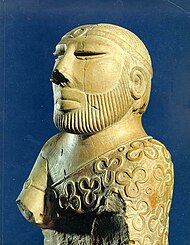
Statue of an Indus priest or king found in Mohenjodaro, 1927
Timeline
  • Category Category
  • Portal Portal

A map outlining historical sites in Pakistan
The history of Pakistan encompasses the history of the region constituting modern-day Pakistan. For over three millennia, the region has witnessed human activity[1] and one of the world's major civilizations, the Indus Valley Civilisation. The trade routes which traverse the Indus Valley linking Central Asia, the Indian subcontinent and the Orient have attracted people from as far as Greece and Mongolia and several imperial powers, the last being the British Empire.

TabishJellani

Contact Form

Name

Email *

Message *

Powered by Blogger.
Javascript DisablePlease Enable Javascript To See All Widget